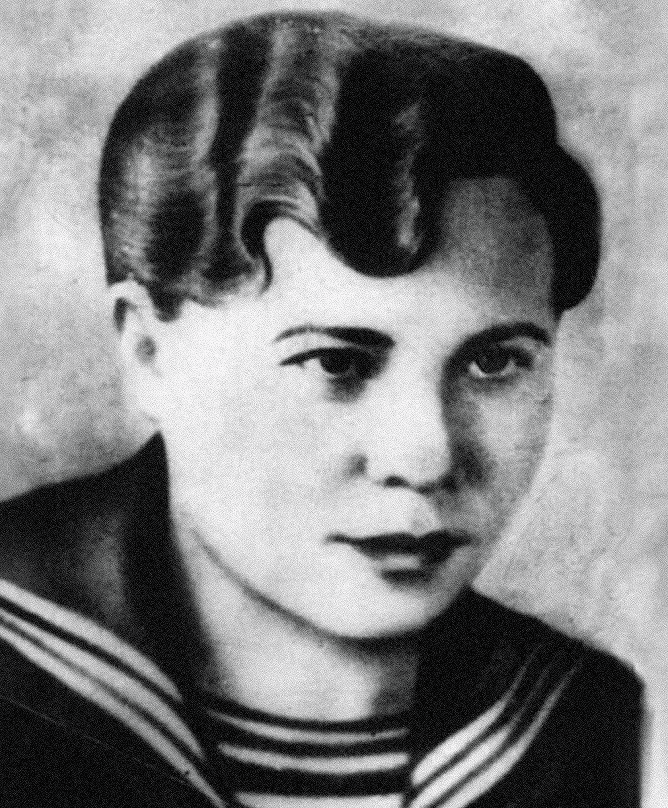
Born on September 14, 1923, in the village of Smolenskoye, in the family of a rural teacher. Russian. She never knew her father — he died a few months before her birth. The girl was raised by her mother and stepfather, Nikolai Vasilyevich.
Her childhood and youth were spent in Krasnoyarsk Krai. She graduated from the Tashtyp Primary School and the incomplete secondary school in the village of Ordzhonikidzevsky, Saralinsky District, Khakass Autonomous Region of Krasnoyarsk Krai, and worked as a telephone operator.
From December 1941, she worked as a nurse in a hospital evacuated from Rostov. Her stepfather and brother went to the front; her brother soon died. After the family moved to Irkutsk, from February to June 1942, she worked at the Irkutsk Aviation Plant in Workshop No. 33 as an apprentice chipper, receiver, and controller of the 4th rank. Without leaving production, she completed courses for medical instructors and, as part of one of the detachments of the “Fleet’s Twenty-Five Thousand” (a decree of the State Defense Committee of the USSR from May 1942 calling 25,000 female volunteers into the Navy), on June 13, 1942, she was drafted into the Navy and sent to serve in the Far East.
She served as a telephone operator and rangefinder in the 51st Artillery Division of the Shkotovsky Coastal Defense Sector. In 1944, after graduating from the Junior Medical Specialists School, Maria was assigned as a nurse to the 3rd Company of the 355th Separate Marine Battalion of the Pacific Fleet.
During the Soviet–Japanese War, on August 14, 1945, Maria Tsukanova, as part of the 355th Marine Battalion, took part in the landing operation in the Korean port of Seishin (now Chongjin). During the battle, she provided medical aid to the wounded and carried 52 wounded marines from the battlefield. She was wounded twice but refused to leave the field.
After her company was forced to retreat on the evening of August 15, Maria Tsukanova stayed behind with a group of soldiers to cover the withdrawal. Despite being wounded, she killed more than 90 Japanese soldiers with automatic fire. Unconscious, she was captured; the Japanese tortured and killed her.
By decree of the Presidium of the Supreme Soviet of the USSR on September 14, 1945, “for exemplary fulfillment of command assignments at the front in the struggle against Japanese imperialists and for the courage and heroism displayed,” Red Army soldier Maria Nikitichna Tsukanova was posthumously awarded the title of Hero of the Soviet Union. Among all women Heroes of the Soviet Union, she was the only one to receive this high title during the Soviet–Japanese War. She was also awarded the Order of Lenin.
GATO (State Archive of the Tyumen Region) F. F1. Op. 5. D. 564.
Tsukanova, Maria Nikitichna. From Wikipedia, the free encyclopedia [Electronic resource] URL: https://ru.wikipedia.org/wiki/%D0%A6%D1%83%D0%BA%D0%B0%D0%BD%D0%BE%D0%B2%D0%B0,_%D0%9C%D0%B0%D1%80%D0%B8%D1%8F_%D0%9D%D0%B8%D0%BA%D0%B8%D1%82%D0%B8%D1%87%D0%BD%D0%B0 (Accessed: 03.11.2025).