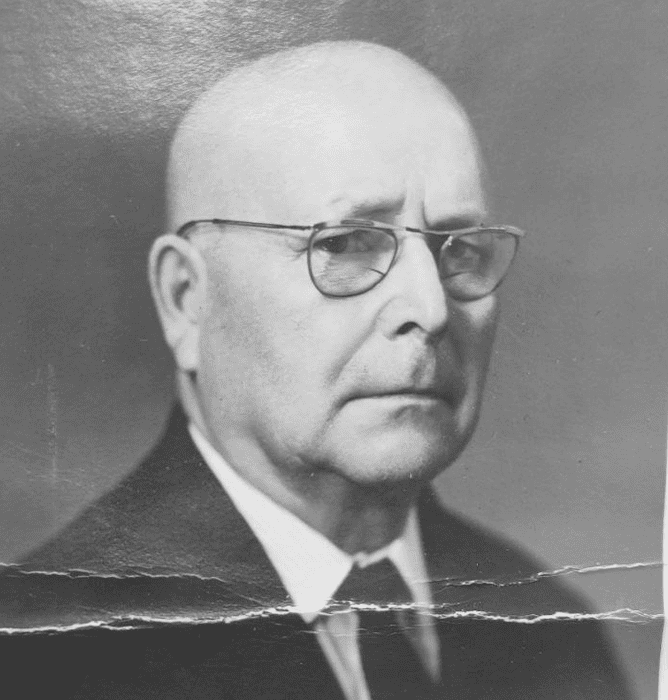
Sazonov P.I. was born on December 19, 1900, in the village of Berezovka, Uvatsky District, Tyumen Region, into a peasant family. In the village of Uvat he graduated from rural school with a commendation certificate and then completed a two-grade school. His teacher, A.F. Zakharova, helped Sazonov P.I. enter the Tobolsk Teachers’ Seminary in 1915 and obtain a scholarship. After graduating from the seminary, Pavel Ivanovich worked as a teacher in the village of Uvat and in the city of Tobolsk. In 1923 he began intensively preparing for university entrance exams, and in 1924 he was admitted to the medical faculty of Perm State University, which he completed in 1929.
Pavel Ivanovich began his medical work as the head of a medical district in the village of Zavodouspenskoe, Tyumen District, where there was a 10-bed hospital. A year later, in 1930, he moved to work in the city of Tyumen, where he continued further. From 1930 to 1934 he worked as a therapist in Clinics No. 1 and No. 3 and as head of the “Peasant Hospital.” On operating days he showed a strong inclination for surgery and regularly visited the surgical department of the city hospital. In 1934 he was sent to Kazan for four-month surgical courses, after which he worked as a surgeon in the Water Transport Workers’ Hospital; in 1935 he became a resident of the surgical department of the Tyumen City Hospital. At the same time, Pavel Ivanovich served as chief physician of Tyumen Clinic No. 3.
In 1937 he completed specialization in ear, throat, and nose in Moscow, and from then on worked as a resident of the surgical department, simultaneously heading surgical care in ear, throat, and nose until 1941.
Pavel Ivanovich performed almost all types of operations, including radical ear surgery and operations on the venous sinus in cases of brain complications. In 1938 alone he opened 15 abscesses of the brain and cerebellum after preliminary ligation of the jugular vein.
In 1938, in connection with the events near Lake Khasan, Pavel Ivanovich worked for two months in the East as head of the surgical department of a hospital, for which he received a commendation from the headquarters of the First Primorye Army.
In 1939 he attended advanced surgical training courses in Kazan.
War. The entire country rose to fight the German–Fascist invaders. Everyone forged victory: both home-front workers and hundreds of thousands of volunteers who went to the front with weapons in their hands, and people of the most humane peaceful profession on earth — doctors.
From the beginning of the Great Patriotic War and until its end, Pavel Ivanovich was the leading surgeon of Military Hospital No. 1498 with 1,000 beds. At the same time, a base for ear, throat, and nose studies of the Krasnodar Medical Institute, evacuated to Tyumen, was organized there. While working at the hospital, Pavel Ivanovich prepared dozens of surgeons and doctors for the front.
At Hospital No. 1498, more than a thousand operations were performed by Pavel Ivanovich Sazonov and the doctors of his surgical department, including operations on the peripheral nervous system.
Upon inspection of the hospital by the People’s Commissar of Health, Sazonov P.I. was awarded the badge “Excellence in Public Health.”
Behind all this lies labor, painstaking labor, sleepless nights, not a moment of relaxation, and the immense gratitude of the people whose lives and ability to work Pavel Ivanovich restored.
Lieutenant Anatoly Butenko had lost both arms at the front and fell into complete despair, unable to imagine his future life without work. He had been in many hospitals in different cities, where he was sent for “further treatment,” and everywhere he was told: “The Krukenberg hand (claw) is performed worldwide at 30 cm below the elbow; your arm is amputated 8 cm below. A lever of 8 cm will be immobile and no operation can make it move.” That was all. In addition, the stump was scar-altered. But then Butenko was sent to a hospital in Tyumen as recovering. In the ward where he stayed, he heard a lot about the leading surgeon P.I. Sazonov, about his exceptional humanity. And so Butenko turned to the surgeon for help. Pavel Ivanovich examined the patient and prescribed training — movement of the ulna and radius. After a few days, thinking through the operation, Pavel Ivanovich decided to use the muscles of the radius to strengthen the muscle strength of the ulna. This approach was completely successful. After removing the scar tissue and forming the claw, there was not enough skin on the stump. Skin was transplanted from the abdomen using the Filatov method. After three additional surgeries, in two months Butenko saw his new hand. It was a great joy — shared by the surgeon, the patient, and the entire surgical department. Butenko worked hard to develop his new hand and learned to use it, to write with it. He entered the pedagogical institute and found his place in life. Time passed, and Pavel Ivanovich received this letter: “Dear Pavel Ivanovich! After graduating from Voronezh State University, I have already worked in three positions. In the 1949–1950 academic year, as a history teacher in the school for working youth; in 1950–1951, as head of the political economy department office at VSU; and since September 1951 I have been recommended by the regional committee of the CPSU as an assistant of the political economy department at the Voronezh Agricultural Institute. Last year I passed the candidate minimum examinations.” How grateful this man must have been to the hands and heart of the surgeon who returned him to life and human joy.
Another episode from Sazonov’s medical career:
Comrade Chusovitin had suffered frostbite to his foot at the front — toes, metatarsus, and heel. Surgery was necessary. A similar operation had earlier been performed by the great Russian surgeon N.I. Pirogov, but in his patient only the toes were frostbitten, while the heel was healthy. Pavel Ivanovich Sazonov decided to modify Pirogov’s operation and create an artificial heel by transplanting the talus bone to replace the frostbitten calcaneus. After long persuasion by all the patients in the ward, Chusovitin agreed to the operation; within weeks he was walking on his foot without a crutch.
Soon a surgeon of the Soviet Army, academician Burdenko, arrived in Tyumen. He stood for a long time by Chusovitin, looking at his foot, making him turn, walk, feeling the artificial heel — and found no flaw. Such was the masterful execution of the operation.
Here are lines from a Sverdlovsk newspaper dated December 22, 1950:
“For more than six years, the chairman of the Lipchinsky village council of the Sverdlovsk region, V.A. Antonov, carried a metal fragment deep in his chest. And all this time it troubled him greatly. Twice a professor from Tambov attempted to remove the fragment, but unsuccessfully. In 1950, Antonov was sent to postgraduate student Sazonov P.I., who immediately suggested he undergo surgery. The operation was extremely complex, as several ribs had to be removed, exposing the lung, heart, and large vessels between which the fragment lay. In the mediastinum, between the heart and the aorta, around the metal fragment there was an abscess. However, the Tyumen surgeon Sazonov P.I. brilliantly performed the operation and removed the fragment, 4×2 cm in size. In addition, a piece of tunic was removed along with the fragment. The operation was performed completely painlessly under local anesthetic, using the method of Soviet scientists — Professors Vishnevsky, Ginsburg, and Osipov. A few days after the operation, the fistula closed and Antonov was forever freed from his severe illness.”
After the war, Sazonov P.I. worked as head of the surgical department of the Tyumen Regional Hospital. During his work in this department he performed an enormous number of operations that saved many people. The medical practice of surgeon Sazonov was marked by great progress, the desire to treat better and more effectively, and by the introduction and use of new treatment methods.
For the first time, Sazonov P.I. performed primary gastric resection for perforated gastric and duodenal ulcers. He conducted 50 such operations; previously, such operations had not been performed in the Tyumen Region. Operations for bronchial asthma — on the artery itself — were also performed here. In 1951, he performed the first operation to create an artificial esophagus through the anterior thoracic approach according to Yudin, but with a skin graft.
From 1947 to 1956 the foundation was laid for major thoracic surgery.
In 1947 Sazonov completed courses in tuberculosis surgery. In 1948 the first operation was performed on patient Motkina, an agronomist suffering from pulmonary tuberculosis — anterior and posterior thoracoplasty, resulting in full recovery. In Sverdlovsk, and later in Moscow, they refused to operate on this patient due to a bilateral process. P.I. Sazonov undertook this difficult operation; the success was evident. Here are the lines from Motkina’s letter: “Dear Pavel Ivanovich! I very much want to share with you my boundless joy and sincerely express my gratitude for your work and your ability to give people the most precious thing — prolongation of life. I feel well. My mood is good, test results are good. My appetite is good. I am very, very grateful to you. Polina Mokshina, 02.02.1948.”
Between 1947 and 1955, P.I. Sazonov performed 300 operations for pulmonary tuberculosis, including thoracoplasty, extrapleural pneumothorax, and cavernotomy.
In 1956, Pavel Ivanovich performed the first heart defect surgeries — at a time when such surgeries were not performed in Sverdlovsk, Omsk, or Chelyabinsk.
Pavel Ivanovich Sazonov also specialized in gynecological and neurosurgical operations. In 1950 he was appointed chief surgeon of the region and held this position until 1965.
In 1954, Pavel Ivanovich organized the Surgical Society in Tyumen and was its permanent chairman until 1965. In that same year, Sazonov retired. But his medical work did not end. Pavel Ivanovich continued working as consultant and surgeon at Clinic No. 1 of the regional health department.
On December 4, 1969, by Order No. 1657, the protocol of the attestation commission was approved, awarding Sazonov P.I. the highest category of physician — surgeon.
Throughout his medical life, Pavel Ivanovich not only provided medical care but always tried to pass on his knowledge and experience to his fellow doctors. He was the organizer, leader, and teacher of many courses and seminars. Pavel Ivanovich Sazonov made many reports and presentations at regional medical congresses and in the Tyumen Surgical Society.
Pavel Ivanovich wrote 12 scientific works (articles), published in medical collections and journals.
The experience of leading specialists and their professional and moral qualities is becoming increasingly important — including the scientific and practical achievements of the remarkable doctor, organizer of surgical services, and prominent public figure P.I. Sazonov. The image of this renowned surgeon and his valuable contribution to the development of healthcare in the Tyumen Region can and should serve as a worthy example for young generations of doctors.
Published scientific works and articles by Sazonov P.I.:
1. Our experience in the surgical treatment of mitral stenosis. Practical issues. Collection of scientific papers, Surgeons, 1961, Issue One.
2. On the issue of ligation of the mammary vessels in coronary insufficiency. Collection of scientific papers, Surgeons, 1961, Issue One.
3. Angina pectoris from the surgeon’s perspective. Brochure. Tyumen State Medical Institute, 1965.
4. Acute appendicitis. Brochure. Tyumen Book Publishing House, 1956.
5. Larré’s diaphragmatic hernia. Journal “Surgery,” No. 8, 1954.
6. Torsioned serous cyst of the greater omentum. “Soviet Medicine,” No. 1, 1952.
7. On the issue of spontaneous ruptures of traumatic aneurysms. Journal “Surgery,” 1949.
8. Anterior mediastinal cyst. Diagnosis and treatment. “Soviet Medicine,” 1953.
9. Posterior mediastinal tumor. Large tuberculous lymph node. Journal “Surgery,” 1948.
10. Review of Professor Korolev’s book “Treatment of Mitral Stenosis.” Medical Newspaper (issue number and year unknown).
11. My impressions from visiting Leningrad and Moscow clinics. Medical Newspaper (issue number and year unknown).
12. Treatment of patients with endarteritis (presentation at the surgeons’ congress).
13. Article in the proceedings of the All-Union Congress of Surgeons (year of publication unknown).
Yerofeev Ya. A. Medical Personnel in Tyumen Hospitals during the Great Patriotic War / Ya. A. Yerofeev // Siberian City: Historical Retrospective and Modern Development Vector: Materials of the Regional Scientific-Practical Conference Dedicated to the 430th Anniversary of Tyumen, Tyumen, May 20, 2016. Tyumen, 2016. – P. 89
Khazheeva I. V. Memories of Evacuation Hospital Workers in Tyumen about Everyday Work during the Great Patriotic War / I. V. Khazheeva // Our Heritage: Local History Conference, (October 20–21, 2015, Zavodoukovsk: Materials of Reports and Communications) – P. 26–30.
Dyachkov V. History of Military Medicine / V. Dyachkov // Tyumenskaya Pravda. – 1986 – September 5.
Sidorova E. Guardian Angels in White Coats / E. Sidorova // Tyumensky Courier. – 2002 – May 8.
Tereb N. “White Waltz” of Tyumen Hospitals / N. Tereb // Tyumenskie Izvestiya. – 2014 – September 11.
Yerofeev Ya. A. Ibid.
Ibid. P. 90.
Ibid.
Kulmukhametova A. During the War, Tyumen Hospitals Treated 70,000 Soldiers / A. Kulmukhametova // Komsomolskaya Pravda. – 2019 – May 9.
Khazheeva I. V. Memories of Evacuation Hospital Workers in Tyumen about Everyday Work during the Great Patriotic War / I. V. Khazheeva // Our Heritage: Local History Conference, (October 20–21, 2015, Zavodoukovsk: Materials of Reports and Communications) – P. 28–29.
Kollegov M. Ordinary Heroism of a Peaceful Profession // TyumenMedia News Agency. Access: https://tyumedia.ru/11756.html (accessed: 12.09.2019)
Heroes of the Rear: Surgery Virtuoso // Tyumenskaya Liniya News Agency. Access: https://t-l.ru/233885.html (accessed: 12.09.2019)