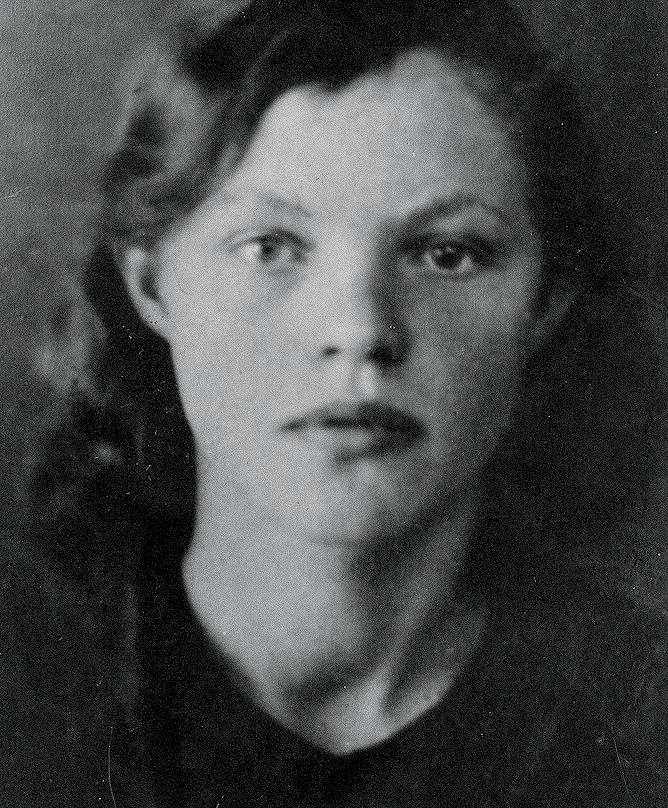
Born on October 18, 1923, in the village of Modolitsy (in what is now the Pskov Region) in the family of a postal worker. After the beginning of the Great Patriotic War, in July 1941, her father was drafted into the ranks of the Red Army, while her mother and Valeria began working at the post office in his place. In September 1941, as German and Finnish troops approached Leningrad, the Gnarovskaya family — her mother, younger sister Viktoria, 75-year-old grandmother, and Valeria — were evacuated to Siberia, to the Ishim station of the Omsk Region (now Tyumen Region).
From there, they were assigned to the village of Berdyuzhye, where Valeria and her mother worked as telephone operators at the Istoshinsk postal branch. Valeria repeatedly appealed to the local district military enlistment office demanding to be sent to the front, but each time she was refused. In the spring of 1942, the Komsomol girls of Berdyuzhye went to the Ishim station and, on April 10, 1942, achieved their enlistment into the newly formed 229th Rifle Division. Thus, Valeria and her friends underwent military training and studied medicine, successfully completing short-term nursing courses.
In July 1942, the division was sent to the Stalingrad Front as part of the 64th Army and immediately entered heavy fighting, in which Valeria Gnarovskaya showed bravery by carrying wounded soldiers from the battlefield. When the situation required, she fought with weapons in hand and, according to the recollections of her front-line friend E. Doronina, would rally Red Army soldiers to attack.
For 17 days, the division fought continuously against the enemy. On August 10, it was encircled and spent a week breaking through to friendly lines (only about 700 of the 5,419 soldiers as of August 5, 1942, made it to the left bank of the Don). During all this time, Valeria performed her medical duties, but soon fell ill with typhoid fever. The soldiers who broke through the encirclement carried the barely alive girl in their arms. She was considered missing in action. While recovering in the hospital, she was awarded the Medal “For Courage.”
The soldiers affectionately called her “Swallow” in their letters to her at the hospital. After the battles of August 15–21, 1943, she was again hospitalized with a concussion but soon returned to her unit. In a letter to her mother dated August 22, she wrote that she was hard of hearing after the concussion and described the circumstances of the battle.
In the battle for the village of Golaya Dolina in the Slavyansk District of the Donetsk Region, near the Seversky Donets River, she carried 47 wounded soldiers and officers with their weapons from the battlefield. She personally killed 28 German soldiers and officers. Throughout the battles, V. O. Gnarovskaya saved the lives of more than 300 wounded soldiers.
On September 23, 1943, during battles near the village of Ivanenki, medical instructor of the 907th Rifle Regiment of the 244th Rifle Division, Private (according to other sources, Sergeant Major) Valeria Gnarovskaya was carrying the wounded to the dressing station. At that moment, two German “Tiger” tanks broke through toward the station. In an effort to save the wounded, Valeria Gnarovskaya threw herself with a bundle of grenades under one of the tanks and blew it up. The second tank was destroyed by the advancing Red Army soldiers. Thanks to her sacrifice, the German counterattack was repelled, the regimental headquarters was saved, and the regiment’s combat mission was accomplished.
After the battle for the village of Verbovoye, local residents found the body of V. O. Gnarovskaya and buried her. A year later, with military honors, her remains were reburied in the park near the House of Culture of the state farm named after V. O. Gnarovskaya in the Krasnoarmeysky District of the Zaporizhzhia Region.
For her courage, heroism, and exemplary fulfillment of command assignments, by the Decree of the Presidium of the Supreme Soviet of the USSR on June 2, 1944, Valeria Gnarovskaya was posthumously awarded the title of Hero of the Soviet Union.
Gnarovskaya, Valeria Osipovna. From Wikipedia, the free encyclopedia [Electronic resource] URL: https://ru.wikipedia.org/wiki/%D0%93%D0%BD%D0%B0%D1%80%D0%BE%D0%B2%D1%81%D0%BA%D0%B0%D1%8F,_%D0%92%D0%B0%D0%BB%D0%B5%D1%80%D0%B8%D1%8F_%D0%9E%D1%81%D0%B8%D0%BF%D0%BE%D0%B2%D0%BD%D0%B0
(Accessed: 03.11.2025).